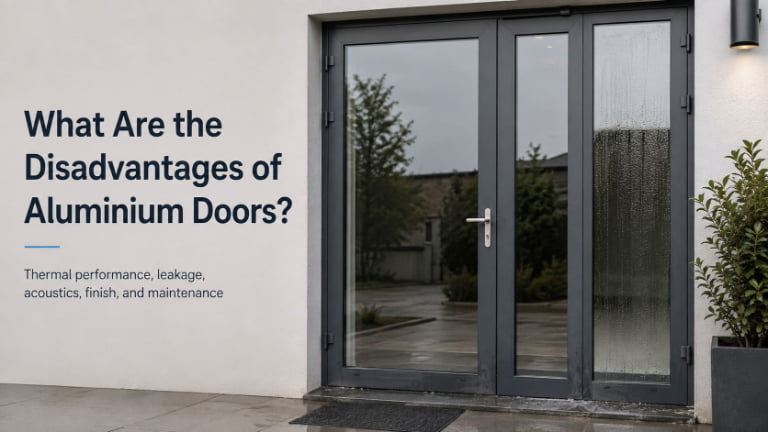
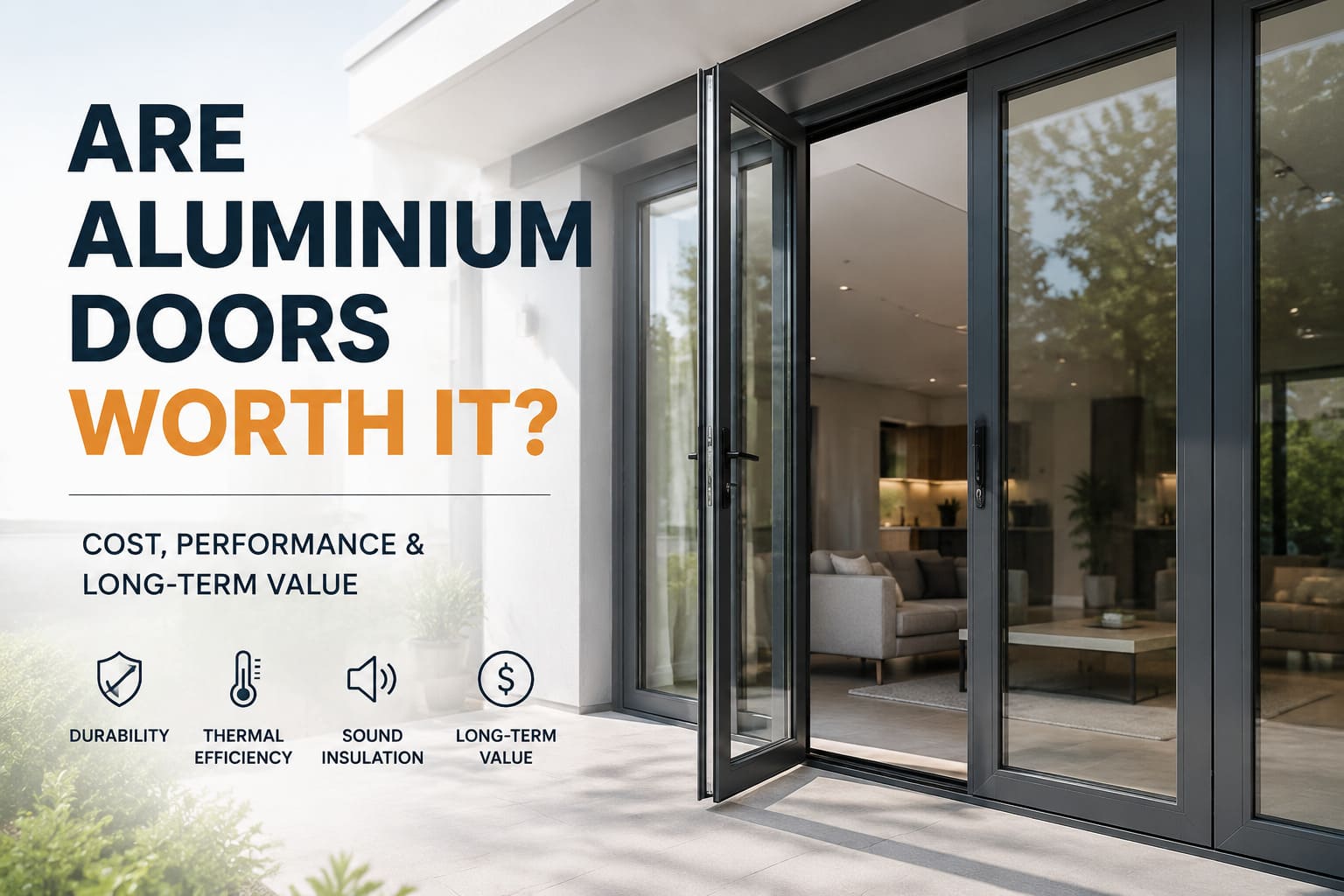
Aluminium doors can look like a sound investment, but an attractive frame and a low quotation do not guarantee reliable project performance. A mismatched system can create condensation, air leakage, hardware failures, or replacement costs.[^1] I recommend evaluating the complete door system against the project’s climate, dimensions, usage, and installation conditions.
Aluminium doors are worth it when the complete system matches the project’s performance requirements. Buyers should assess the profiles, thermal break, glass, hardware, seals, surface finish, fabrication, and installation together. A well-specified system can provide stable quality and design flexibility, while a poorly matched system can create avoidable maintenance and performance problems.
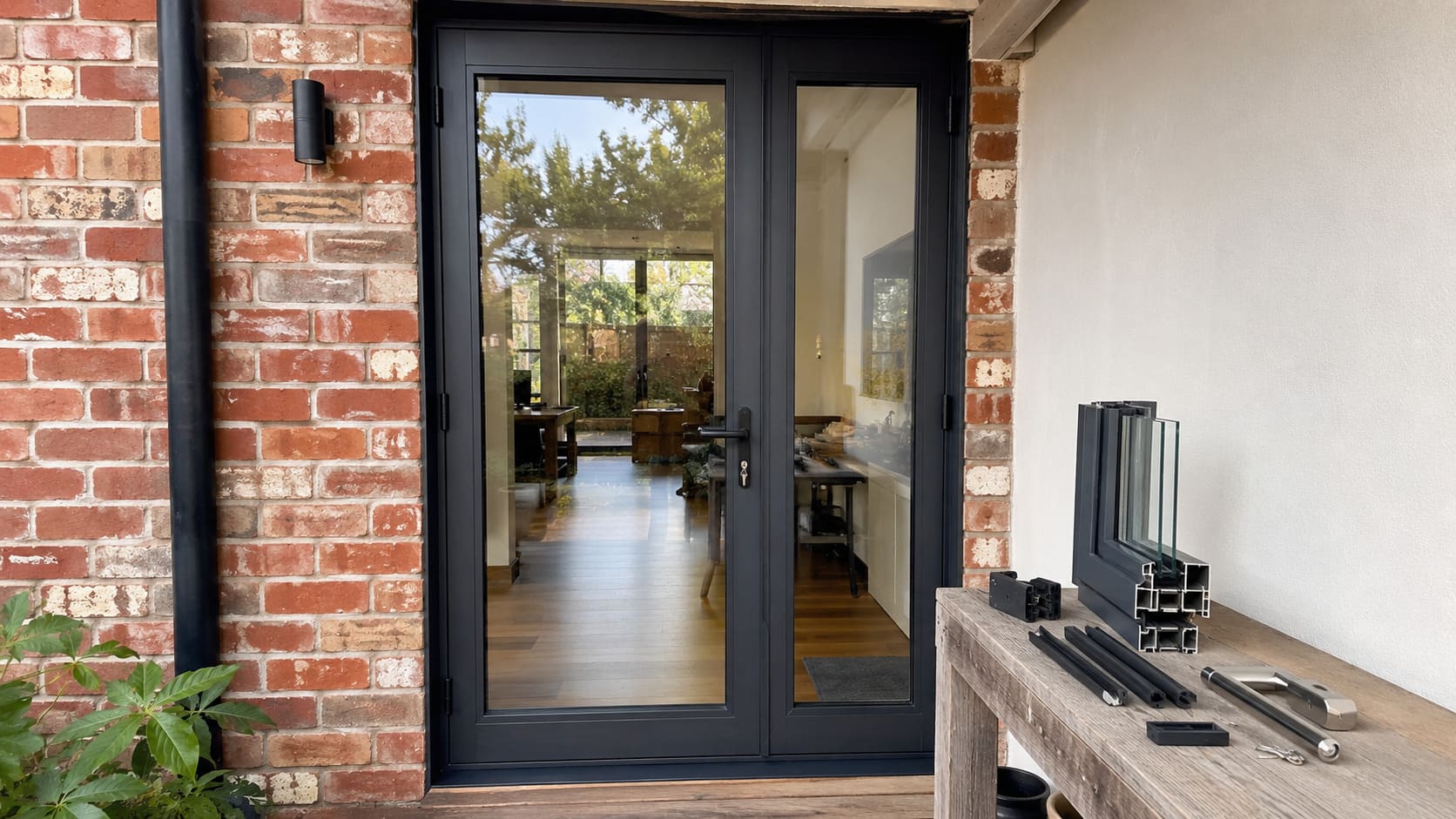
From our manufacturing and quotation experience, I have found that the most useful question is not whether aluminium is generally “good.” I ask whether a particular door configuration can control the risks of a specific building, opening, climate, and operating pattern.
When Are Aluminium Doors Worth the Investment?
A buyer may see two similar-looking aluminium doors with very different prices. That difference can be difficult to explain during procurement, especially when drawings and quotations use inconsistent descriptions. If buyers focus only on appearance or cost per square metre, they may overlook the components that determine long-term performance.
Aluminium doors are generally worth the investment when buyers need dimensional flexibility, repeatable production, durable finishes, large project quantities, or custom system integration. However, the value depends on correct engineering, controlled fabrication, suitable hardware, appropriate glazing, and qualified installation. Aluminium alone does not make a door suitable for every building.
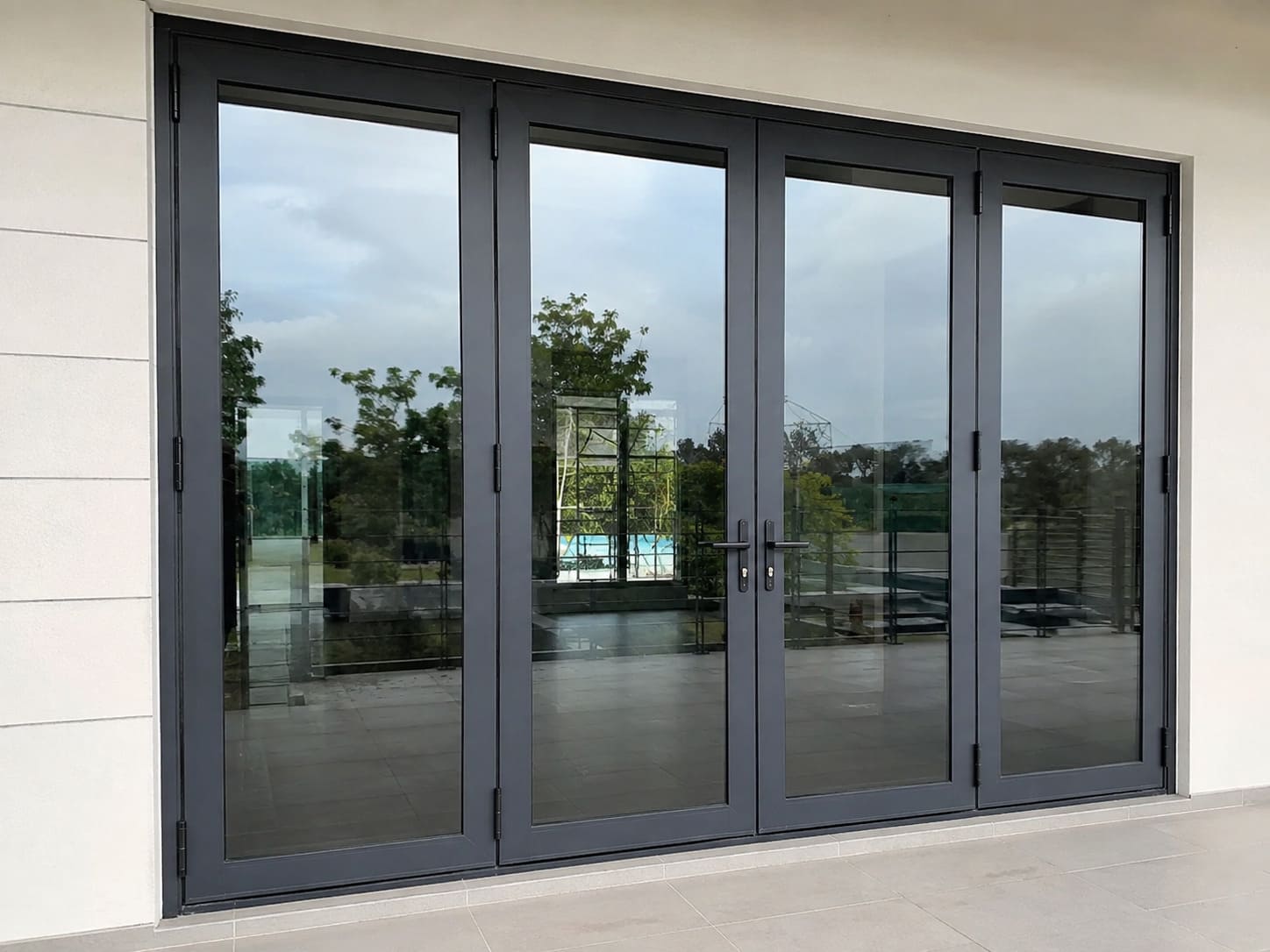
I Treat Value as a Project-Risk Calculation
In my experience reviewing customer drawings and enquiries, the initial question is often, “What is your price for this door?” I usually need to ask several more questions before I can recommend a system or prepare a meaningful quotation.
I normally clarify:
- Where will the doors be installed?
- What are the structural opening dimensions?
- Is the project in a hot, cold, humid, coastal, or high-wind environment?
- Is the door internal, sheltered, or directly exposed?
- How frequently will occupants operate it?
- Does the project require a thermal or non-thermal system?
- What glass composition is specified?
- What hardware brand, grade, or operating capacity is required?
- What surface finish and colour does the buyer expect?
- Which performance standards appear in the project documents?
- Who will handle site measurement and installation?
These questions change the risk profile. For example, a lightly used internal door and a large external entrance door do not require the same configuration. A standard hinge, lock, or roller may work well on one opening but become unsuitable when the sash is taller, wider, heavier, or used hundreds of times each day.
What Value Can a Suitable System Provide?
For B2B projects, I usually see value in four main areas:
- Design flexibility: Aluminium extrusion allows manufacturers to develop system-specific and drawing-based profiles.[^2]
- Production consistency: Controlled tooling, extrusion, finishing, cutting, machining, and assembly can support repeatable project supply.[^3]
- Finish selection: Buyers can specify options such as powder coating, anodizing, wood-grain finishing, or PVDF coating, subject to application requirements.
- System integration: Profiles can be configured around selected glass, hardware, seals, drainage paths, thresholds, and opening methods.
However, buyers should verify each benefit rather than assume it. The manufacturer should confirm the selected alloy, temper, profile dimensions, tolerances, finish specification, hardware compatibility, and inspection process in the purchase documents.
I view aluminium doors as worthwhile when the specification reduces project risk. I do not view them as automatically worthwhile because aluminium is associated with strength or modern design.
A Practical Value Test
I use the following questions as an early procurement filter:
| Evaluation point | Positive sign | Warning sign |
|---|---|---|
| System selection | Supplier asks about climate, dimensions, usage, and performance | Supplier recommends one system for every project |
| Drawings | Shop drawings show profiles, glass, hardware, and key interfaces | Quotation includes only overall dimensions |
| Materials | Alloy, temper, finish, and key dimensions are documented | Material descriptions remain vague |
| Hardware | Hardware is matched to sash size, weight, and operation | Hardware is selected only by price |
| Quality control | Supplier explains inspection points and records | Supplier relies on visual checks alone |
| Installation | Interface, drainage, fixing, and sealing requirements are reviewed | Installation is treated as unrelated to door performance |
No single row proves quality. Still, this comparison helps a procurement team identify where further technical clarification is needed.
Which Components Determine Whether Aluminium Doors Perform Well?
A door can use a suitable aluminium profile and still fail to meet expectations. Glass, hardware, gaskets, fabrication, drainage, and installation all influence the finished result. If one component is incompatible or poorly controlled, the buyer may face air leakage, difficult operation, water entry, or premature maintenance.
Aluminium doors perform as complete systems rather than isolated frames. Buyers should evaluate the profile design, wall thickness, reinforcement strategy, glazing, seals, hardware, drainage, fabrication tolerances, surface treatment, and installation interface together. The system should also suit the opening size, exposure, operating frequency, and required performance documentation.
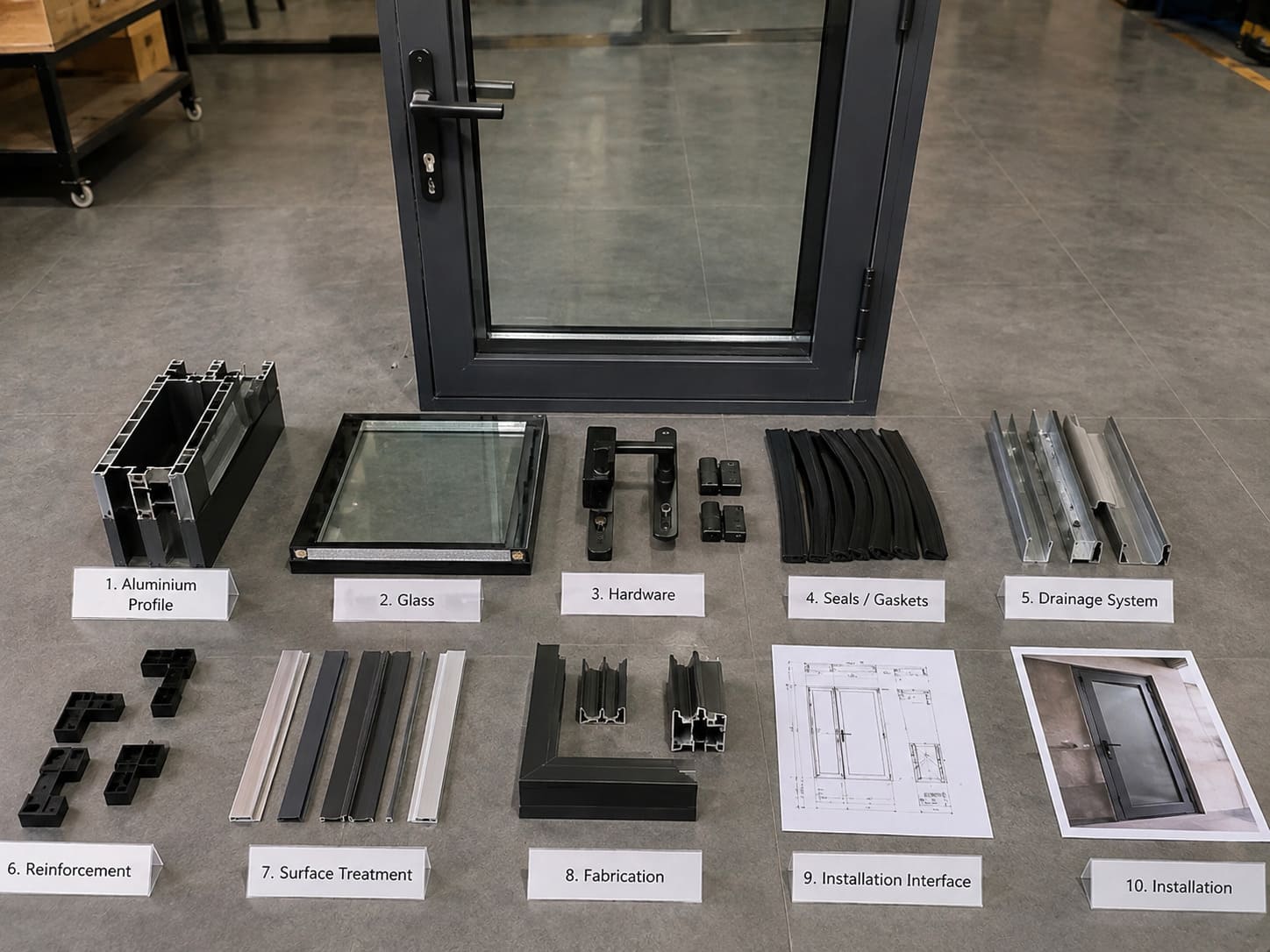
Profile Design and Material Specification
The profile is important, but a catalogue cross-section does not tell the whole story. I review how profiles connect, where loads transfer, how hardware attaches, and whether the system provides suitable locations for gaskets, glass support, drainage, and fixing.
Architectural profiles often use alloys such as 6063, with tempers such as T5 or T6[^4], but the appropriate specification depends on the profile design, manufacturing process, and project requirement. Buyers should not treat an alloy designation as proof that the finished door will meet structural or operational needs.
The purchase specification should identify, where applicable:
- Alloy and temper
- Nominal profile dimensions
- Critical wall thicknesses
- Linear weight or approved cross-section
- Permitted tolerances
- Surface treatment
- Colour reference and acceptable variation
- Thermal-break construction
- Required testing or inspection documents
I also recommend using approved samples or signed profile drawings. Verbal descriptions such as “heavy duty” or “high quality” are too subjective for consistent production.
Glass and Glazing Details
Glass can represent a substantial part of the sash weight. Its composition also affects thermal, solar, safety, acoustic, and optical performance.[^5] I therefore ask buyers to specify more than “double glass” or “tempered glass.”
A useful glazing description may include:
- Pane thicknesses
- Air or gas cavity width
- Coating type and coated surface
- Tempered, heat-strengthened, laminated, or other safety configuration
- Spacer type
- Decorative requirements
- Edge clearance and setting method
- Relevant safety or performance standards
A supplier should check whether the selected profiles, glazing beads, gaskets, hinges, rollers, and corner connections can support the proposed glass configuration. A change in glass thickness can affect both sash weight and compatibility with the profile system.
Hardware, Seals, and Operating Type
A casement door, sliding door, folding door, and lift-and-slide door create different mechanical demands.[^6] I do not recommend comparing their hardware as if it were interchangeable.
Hardware selection should account for:
- Sash width, height, and calculated weight
- Opening direction
- Expected operating frequency
- Exposure to wind, rain, dust, or salt
- Security requirements
- Accessibility requirements
- Maintenance and replacement availability
Seals also require attention. The supplier should document the gasket material, shape, installation method, corner treatment, and continuity. A good profile cannot compensate for missing gaskets, compressed seals, blocked drainage, or poorly adjusted locking points.
Fabrication and Installation Control
Fabrication converts system drawings into a working product. Cutting accuracy, machining positions, corner assembly, hardware installation, glass setting, and final adjustment all matter.[^7]
Our integrated production process lets us review extrusion, finishing, cutting, machining, and door assembly under one manufacturing structure. However, I still encourage buyers to request project-specific quality records. A factory’s broad capability does not remove the need for inspection.
Installation remains equally important. The installer should review:
- Opening dimensions and tolerances
- Frame fixing positions
- Plumb, level, and diagonal alignment
- Perimeter gaps
- Sealant and backing materials
- Sill support and drainage
- Final sash and hardware adjustment
Application-specific structural, waterproofing, safety, and installation decisions should be evaluated by qualified project professionals.
Are Thermal-Break Aluminium Doors Worth It?
Buyers often assume that adding a thermal break automatically creates an energy-efficient door. That assumption can lead to overspending on an incomplete configuration or underspecifying a demanding building envelope. Condensation and heat transfer depend on the whole assembly, not only the insulating strip inside the profile.[^8]
Thermal-break aluminium doors can be worthwhile in climates or buildings with significant thermal and condensation-control requirements. However, buyers must also evaluate the glass, spacer, gaskets, threshold, frame design, air leakage, fabrication quality, and installation. The required system performance should come from project calculations, applicable standards, and qualified professional review.
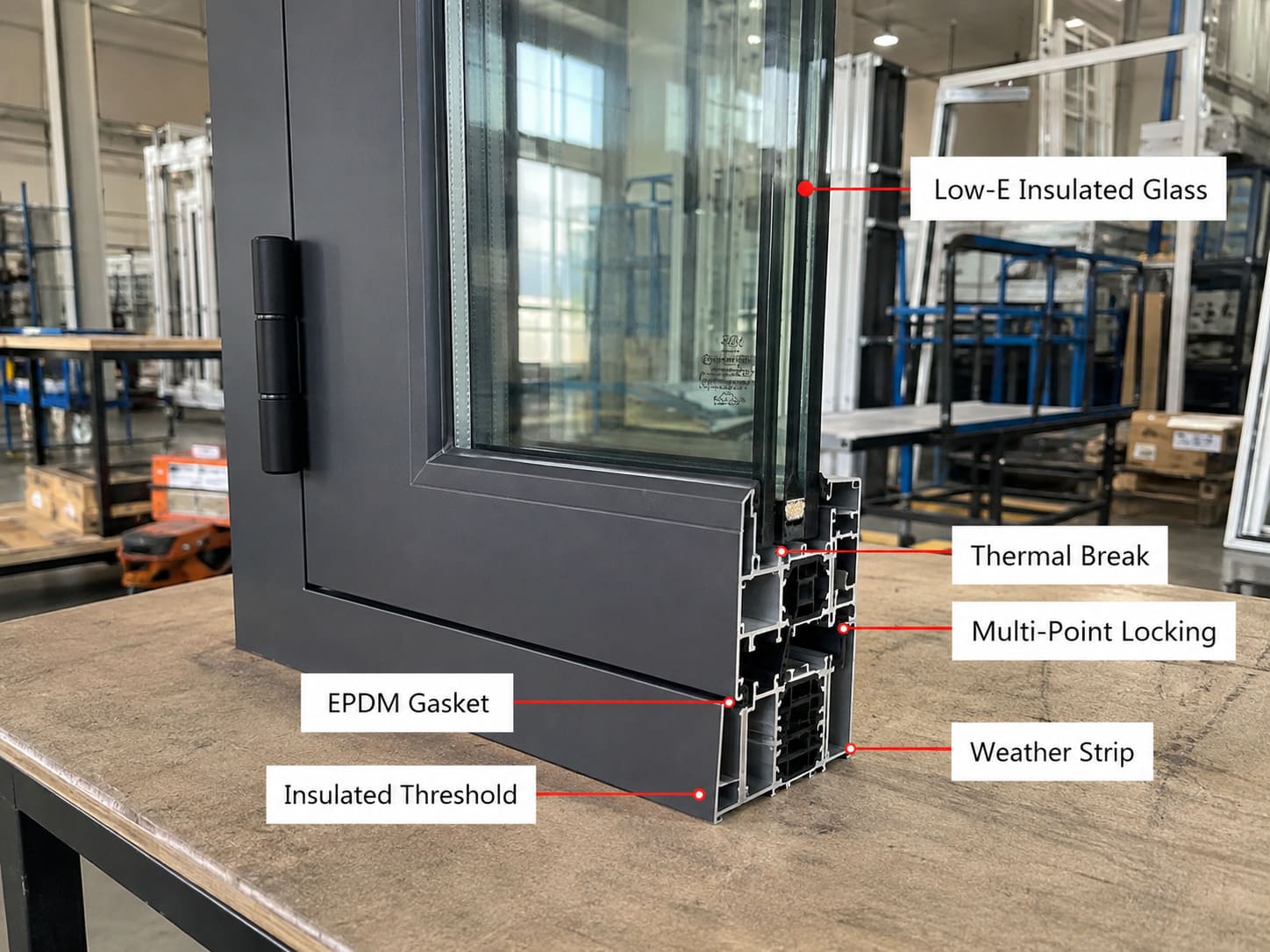
What Does a Thermal Break Actually Do?
A thermal break separates inner and outer aluminium sections with a lower-conductivity material. This design can reduce direct heat flow through the frame.[^9] It does not eliminate heat transfer, and it does not independently determine the performance of the entire door.
Thermal-break dimensions and construction methods vary by system. Buyers should confirm:
- Thermal-break material
- Strip dimensions and geometry
- Assembly method
- Shear and transverse performance requirements
- Compatibility with the selected finish
- Finished profile inspection method
- Supporting test reports for the relevant system
I recommend checking whether reports refer to the actual system being purchased. A certificate or test report for a different profile series, glass configuration, size, or opening type may not establish the performance of the quoted product.
The Weakest Interface Can Control the Result
I have reviewed enquiries where the buyer requested a thermal-break frame but left the glass, spacer, threshold, and perimeter sealing undefined. That creates an incomplete specification.
The following parts affect thermal and condensation performance:
| Component | Why it matters |
|---|---|
| Frame and sash | Profile geometry and thermal-break design influence frame heat flow |
| Insulating glass | Pane construction, cavity, coatings, and gas fill affect centre-of-glass performance |
| Glass edge | Spacer selection influences edge temperatures and condensation risk[^10] |
| Threshold | Low thresholds may create different thermal and weather-sealing challenges |
| Gaskets | Seal continuity affects uncontrolled air movement |
| Hardware | Locking points influence compression against seals |
| Fabrication | Gaps and inaccurate machining can reduce system integrity |
| Installation joint | Perimeter insulation and sealing affect real building performance |
Buyers should request the appropriate performance values required by their market, which may include thermal transmittance, air permeability, watertightness, wind resistance, and condensation-related analysis. The exact metrics, units, test methods, and acceptance limits vary between jurisdictions.
I avoid promising a fixed energy-saving percentage or return period. Those figures depend on climate data, building design, door area, occupancy, HVAC operation, installation quality, and local energy costs. Independent modelling is more reliable than a general sales estimate.
When Can a Non-Thermal System Be Reasonable?
A non-thermal system may be appropriate for some internal spaces, mild climates, warehouses, utility areas, or cost-sensitive applications without demanding envelope requirements. The project designer should still assess condensation, comfort, weather exposure, and local code obligations.
I would be cautious when a non-thermal aluminium door is proposed for:
- Heated buildings in cold climates
- Air-conditioned buildings in hot and humid climates
- Projects with strict energy targets
- Locations with known condensation risk
- High-performance façades
- Occupied spaces where interior surface temperature matters
In these conditions, the lowest-priced non-thermal option may create a higher project risk. A qualified façade consultant, architect, engineer, or building-physics professional should confirm the final specification.
How Should Buyers Compare Aluminium Door Quotations?
Three suppliers can quote the same door schedule and still price very different products. One quotation may include upgraded glass, branded hardware, export packaging, and fabrication drawings, while another may omit them. Without a standard scope, the lowest number does not represent a valid like-for-like comparison.
Buyers should compare aluminium door quotations only after standardising the profile system, glass, hardware, finish, dimensions, accessories, packaging, testing, documentation, and delivery scope. They should then evaluate manufacturing control, customisation, quality records, lead times, communication, and after-sales support alongside the final price.
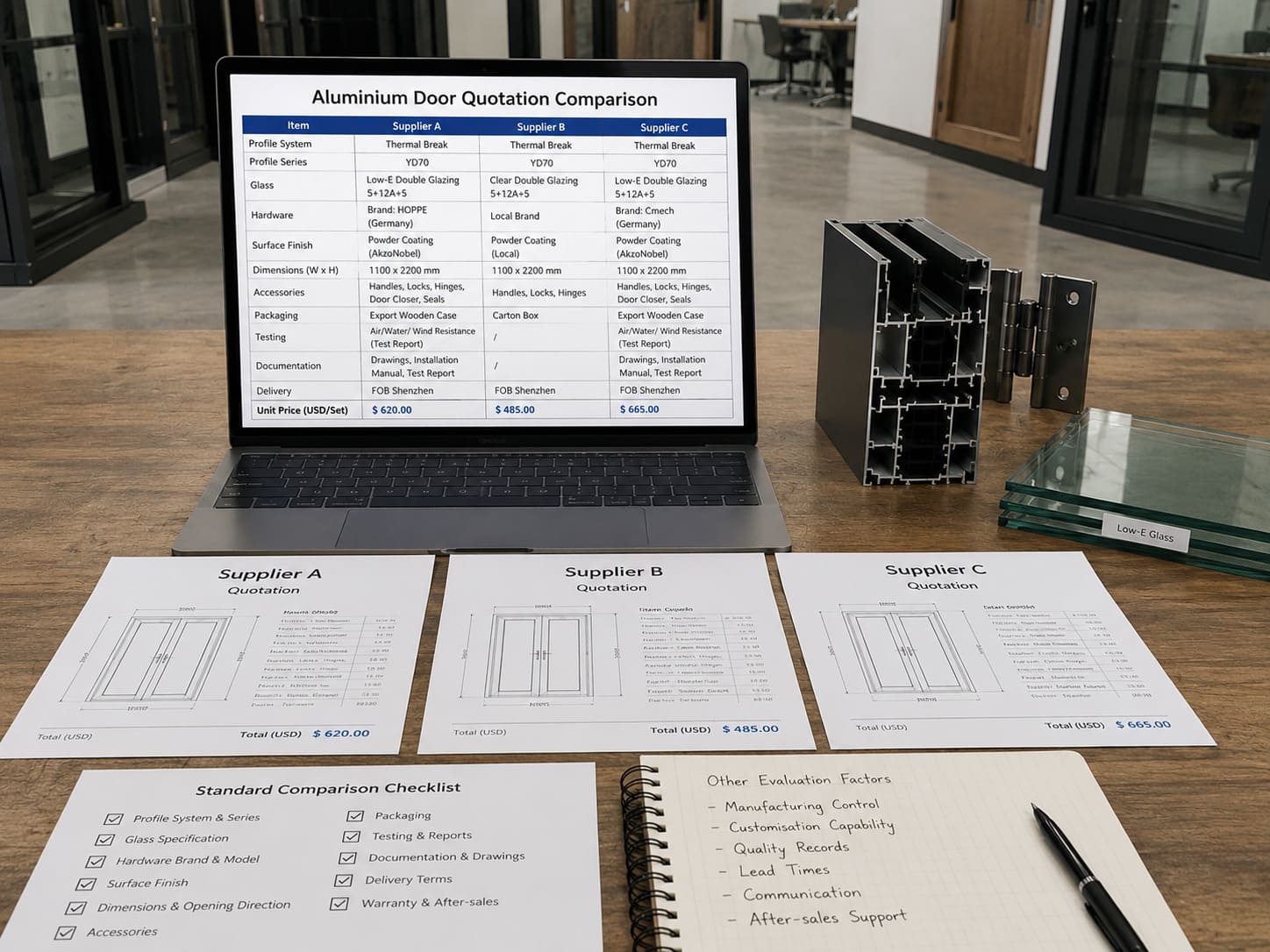
Create One Technical Quotation Schedule
I recommend sending every shortlisted supplier the same request for quotation. The document should include drawings, a door schedule, quantities, required standards, delivery destination, and commercial terms.
At minimum, I would standardise these items:
- Door type: Casement, sliding, folding, lift-and-slide, or another configuration
- Overall dimensions: Width, height, and number of panels
- Profile system: Thermal or non-thermal, series, and approved cross-sections
- Material: Alloy, temper, critical dimensions, and finish
- Glass: Full pane and cavity specification
- Hardware: Brand, model, finish, function, and included accessories
- Seals: Material and configuration
- Performance: Required standards, classifications, and evidence
- Fabrication: Shop drawings, samples, tolerances, and inspection requirements
- Packaging: Protection method, labelling, crate or rack arrangement
- Logistics: Incoterm, port, delivery scope, and documentation
- Services: Design support, installation guidance, spare parts, and warranty terms
If bidders propose alternatives, I ask them to list every deviation. This practice prevents substitutions from becoming hidden inside a lower total price.
Examine the Supplier’s Manufacturing Control
I look beyond production photographs. Buyers should determine which processes the supplier controls directly and which processes are subcontracted.
Useful supplier questions include:
- Does the supplier extrude the profiles or purchase them elsewhere?
- How does the supplier inspect incoming aluminium, glass, hardware, and seals?
- How does the factory control colour between production batches?
- Which dimensions receive in-process inspection?
- How does the factory verify hardware machining positions?
- Does the supplier conduct trial assembly or operational checks?
- How are nonconforming products identified and corrected?
- Can the supplier provide traceable inspection records?
- How does the supplier protect finished surfaces during packing and transport?
Our own integrated capabilities cover extrusion, powder coating, anodizing, wood-grain finishing, PVDF coating, thermal-break processing, machining, and door fabrication. From that experience, I have learned that process integration can improve coordination, but buyers should still verify the actual quality plan for their order.
Verify Documents Instead of Relying on Logos
A supplier may display certificates, test reports, or compliance marks. Buyers should treat these as documents to verify rather than general guarantees.
I suggest checking:
- Issuing organisation
- Certificate holder
- Product and system covered
- Referenced standard
- Report or certificate number
- Issue and expiry dates
- Tested specimen dimensions
- Glass and hardware configuration
- Manufacturing location
- Permitted use of the mark
- Whether online verification is available
Project teams should also confirm whether imported doors need local registration, labelling, fire classification, safety glazing documentation, or other approvals. A qualified local professional should review regulatory compliance.
Use More Than the Purchase Price
A practical supplier comparison can use a weighted score. The exact weighting should reflect the project, but the following model provides a starting point:
| Category | Example weighting |
|---|---|
| Technical compliance | 30% |
| Manufacturing and quality control | 20% |
| Price and payment terms | 20% |
| Delivery capability | 10% |
| Customisation and drawing support | 10% |
| Documentation and communication | 5% |
| Packaging and after-sales support | 5% |
These percentages are not an industry rule. I use them only to illustrate how procurement teams can prevent the lowest price from overriding critical technical risks.
When Are Aluminium Doors Not Worth It?
Aluminium can be specified out of habit, even when the budget, performance requirement, or supply chain does not support a suitable system. If a project cannot define its needs or verify production quality, an aluminium quotation may create false confidence rather than genuine value.
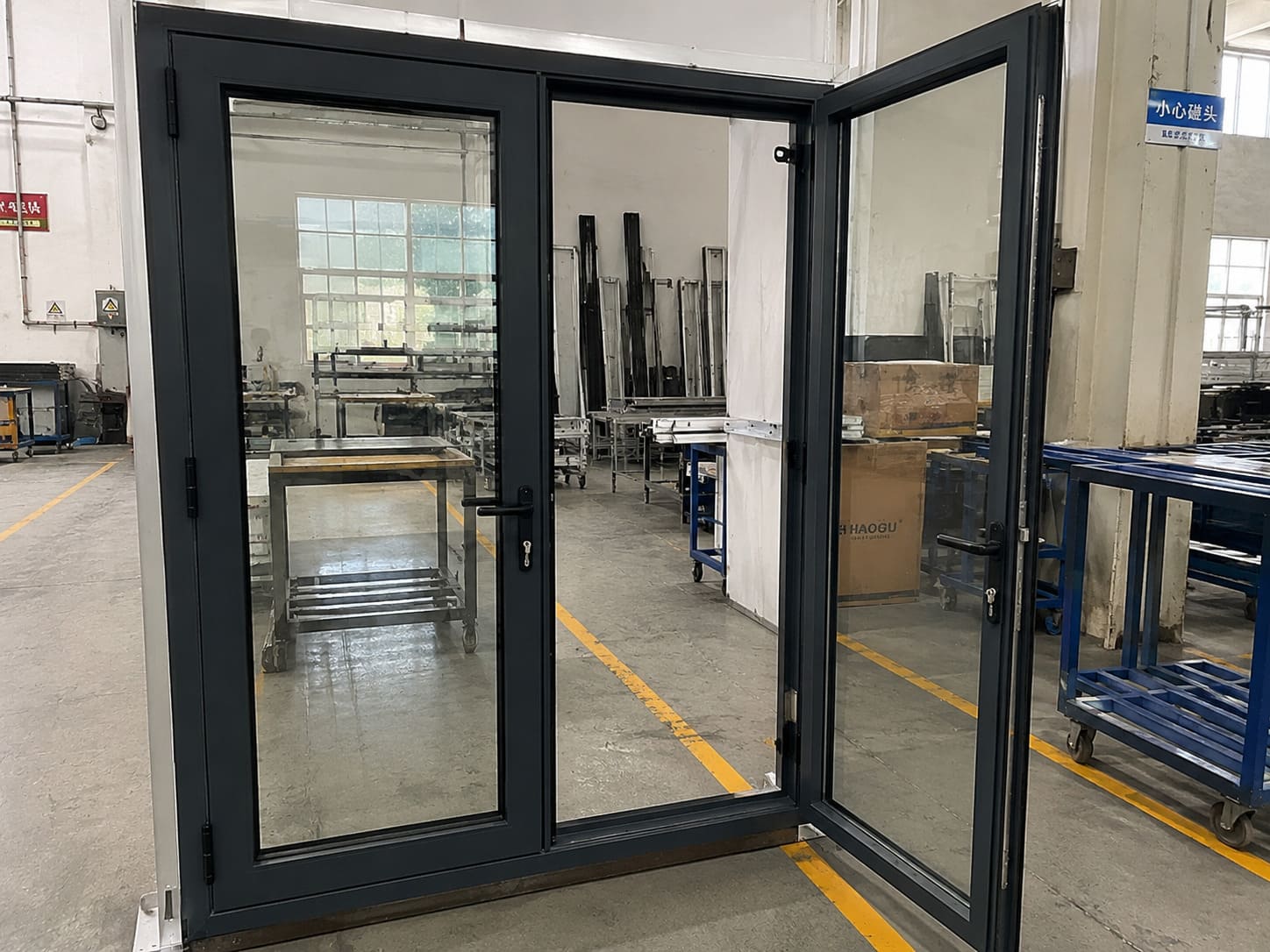
Aluminium doors may not be worth it when minimum initial cost is the only priority, when the proposed system does not suit the climate, or when the supplier cannot demonstrate system-level control. Buyers should also reconsider them when another material or system can meet the verified requirements with lower project risk.
Clear Warning Conditions
I would pause procurement when I see any of the following:
- A supplier recommends a system before reviewing the location and opening sizes.
- The quotation does not identify profile, glass, or hardware specifications.
- A non-thermal door is proposed for demanding thermal conditions without analysis.
- Large or heavy sashes use hardware with no documented capacity.
- The supplier cannot provide profile drawings or confirm critical dimensions.
- Finish requirements rely only on a colour name rather than an agreed sample or reference.
- Test reports cover a different product from the quoted system.
- Site installation responsibilities remain undefined.
- Replacement hardware or spare components will be difficult to obtain.
- The quoted lead time does not allow for drawings, samples, tooling, testing, and inspection.
Initial Cost Is Only One Part of Procurement Risk
I do not recommend using unverified lifetime-cost claims. However, buyers can still compare foreseeable cost categories without inventing a promised lifespan.
A project-level review can include:
- Initial purchase price
- Shop drawing and design coordination cost
- Tooling or mould cost for custom profiles
- Testing and approval cost
- Shipping, duties, and handling
- Installation and access cost
- Adjustment and commissioning
- Cleaning and scheduled maintenance
- Hardware replacement availability
- Cost of water leakage or condensation remediation
- Cost of delayed handover
- Cost of replacing noncompliant units
The procurement team should assign project-specific assumptions to these categories. It should also test high-risk assumptions with the architect, engineer, façade consultant, installer, and cost manager.
For some temporary buildings or low-specification internal applications, a premium aluminium system may not provide enough additional value. In other projects, under-specifying the door can expose the building to much greater costs. I therefore base the decision on documented requirements rather than material preference.
Frequently Asked Questions
Are aluminium doors more expensive than other door systems?
Aluminium doors can have a higher or lower purchase price depending on the system, dimensions, glass, hardware, finish, quantity, and manufacturing scope. I recommend comparing equivalent specifications instead of comparing material names. A low quotation may exclude important components, documentation, packaging, or services.
Are thermal-break aluminium doors always necessary?
Thermal-break aluminium doors are not necessary for every application. Their suitability depends on climate, building use, energy requirements, condensation risk, and local regulations. I recommend professional thermal review for demanding external applications, especially when the project uses heating or air conditioning.
What should I send a manufacturer for an accurate quotation?
I recommend sending architectural drawings, opening dimensions, quantities, location, door types, performance requirements, finish, glass, hardware preferences, and delivery terms. If complete drawings are unavailable, reference photos and project requirements can support an initial proposal, but the final order should use approved technical drawings.
How can I check the quality of aluminium doors before shipment?
Buyers can review approved drawings, material documents, profile dimensions, finish samples, hardware models, glass markings, assembly quality, operation, packaging, and inspection records. I also recommend defining an inspection plan before production. Independent pre-shipment inspection may be useful for large or technically sensitive orders.
Can aluminium doors be fully customised?
Manufacturers can often customise profile dimensions, colours, finishes, glass, hardware, opening methods, machining, and packaging. However, customisation may require new extrusion dies, samples, minimum quantities, testing, or longer lead times. I confirm these conditions before treating a custom design as production-ready.
Conclusion
Aluminium doors are worth it when the entire system is selected and manufactured for the actual project. I recommend evaluating climate, opening size, usage, profiles, thermal design, glazing, hardware, seals, fabrication, and installation before comparing prices. Buyers should standardise quotation scopes and verify supplier documents, capabilities, and quality controls.
We support B2B buyers with drawing-based production, custom profiles, finishes, glazing, hardware matching, and project-specific door solutions. To discuss your requirements, contact us at +86 18366906856 or [email protected].
[^1]: "Development of Thermal - Envelope Design Guidelines", https://nvlpubs.nist.gov/nistpubs/Legacy/IR/nistir4416.pdf. Building-envelope research identifies inappropriate component selection and discontinuities at frames, seals, and installation joints as recognized contributors to condensation, air leakage, operational defects, and subsequent remedial work; it does not establish that every mismatched door will experience all of these outcomes. Evidence role: general_support; source type: research. Supports: Building-envelope research documenting how unsuitable components, discontinuous seals, and deficient installation can cause condensation, air leakage, operational problems, and remediation.. Scope note: The evidence supports the general risk relationship, while the occurrence and cost of a failure depend on the specific assembly and exposure. [^2]: "Analysis of the Extrusion Process of Aluminium Alloy Profiles", https://www.academia.edu/95592996/Analysis_of_the_Extrusion_Process_of_Aluminium_Alloy_Profiles. Technical descriptions of aluminium extrusion explain that a billet is forced through a shaped die to produce a continuous profile with the die's cross-sectional geometry, supporting the feasibility of system-specific profiles; practical geometries remain constrained by alloy, die design, tolerances, and manufacturability. Evidence role: mechanism; source type: education. Supports: The extrusion process forces aluminium through a shaped die, producing long components with a specified cross-section.. Scope note: The process supports customization in principle but does not prove that every proposed profile can be manufactured economically or to the required tolerances. [^3]: "Quality and Consistency of Machined Components and ...", https://www.nist.gov/system/files/documents/oles/2-Donmez-Alkan-Manufacturing-2012-07-10-MSSFFA.pdf. Manufacturing-quality research describes process control, measurement, and corrective action as means of limiting production variation and improving repeatability across batches; this general principle does not demonstrate the consistency of any particular door factory. Evidence role: mechanism; source type: research. Supports: Manufacturing process control and in-process measurement are used to reduce variation and improve product consistency.. Scope note: Direct support for a specific supplier would require factory records, inspection results, or process-capability data. [^4]: "6063 Aluminum: Get to Know its Properties and Uses", https://www.gabrian.com/6063-aluminum-properties/. Materials references identify 6063 as a readily extruded aluminium alloy widely used for architectural sections and recognize T5 and T6 as established heat-treatment tempers; these designations alone do not establish the structural adequacy of a finished door. Evidence role: general_support; source type: education. Supports: Materials references characterize 6063 as an extrusion alloy widely associated with architectural applications and list T5 and T6 among its standard tempers.. Scope note: Suitability still depends on section geometry, mechanical properties, loads, fabrication, and applicable design standards. [^5]: "Glazing Material for Solar and Architectural Applications", https://windows.lbl.gov/publications/glazing-material-solar-and. Window and glazing research shows that pane construction, coatings, interlayers, cavity design, and gas fill can alter thermal transmittance, solar heat gain, visible transmittance, acoustic response, and post-breakage behavior; the magnitude of each effect depends on the complete glazing configuration. Evidence role: mechanism; source type: research. Supports: Pane thickness, laminates, coatings, cavities, and gas fills influence the heat transfer, solar transmission, sound reduction, breakage behavior, and visible properties of glazing.. Scope note: A general glazing source cannot establish performance values for an unspecified glass unit. [^6]: "EN 1527:2019+A1:2021 - Sliding & Folding Door ...", https://standards.iteh.ai/catalog/standards/cen/b5450bc7-4df5-4444-b016-42328376716a/en-1527-2019a1-2021?srsltid=AfmBOoqOWd7ALF6VJqbplbFGgBkRFIlr7y4iZJY_8QenxkvPfG364WAv. Fenestration standards and technical guidance distinguish hinged, sliding, folding, and related operating types because they transfer dead load and operating forces through different hinges, rollers, tracks, pivots, and locking arrangements; this distinction does not by itself determine the required hardware capacity for a specific door. Evidence role: mechanism; source type: institution. Supports: Door configurations transfer sash weight and operating forces through different components and are consequently tested or rated according to configuration-specific requirements.. Scope note: Configuration-specific calculations and manufacturer ratings are still needed for the actual sash size, weight, exposure, and duty cycle. [^7]: "SECTION 085113", https://www.fitchburgma.gov/DocumentCenter/View/10466. Fenestration standards and technical guidance identify dimensional accuracy, joint integrity, glass support, hardware positioning, and final adjustment as relevant to operability and air- and water-control performance; they provide general support rather than proof of the quality of a particular fabricated unit. Evidence role: general_support; source type: institution. Supports: Fenestration standards and technical manuals treat dimensional tolerances, joint assembly, glazing support, hardware placement, and adjustment as factors in proper operation and tested performance.. Scope note: Product-specific compliance requires inspection or testing of representative units made under the relevant production controls. [^8]: "THERM 7 / WINDOW 7 NFRC Simulation Manual", https://windows.lbl.gov/sites/default/files/Downloads/NFRCSim7-July2017.pdf. Whole-product fenestration research evaluates heat transfer and interior surface temperatures across the frame, glazing, glass edge, and other interfaces, confirming that a thermal-break strip alone does not determine door U-factor or condensation resistance. Evidence role: expert_consensus; source type: research. Supports: Whole-product fenestration methods account for frame, centre-of-glass, edge-of-glass, geometry, air leakage, and boundary conditions when assessing thermal performance and condensation.. Scope note: Calculated or laboratory performance may differ from in-service performance because of size, climate, workmanship, air leakage, and installation details. [^9]: "Core Research Support for BTO Windows Program", https://www.energy.gov/cmei/buildings/articles/core-research-support-bto-windows-program. Building-energy guidance defines a thermal break as a low-conductivity separator between interior and exterior metal frame sections that interrupts the direct conductive path and reduces frame heat transfer; it does not eliminate conduction through the assembly. Evidence role: mechanism; source type: government. Supports: Government building-energy guidance explains that a low-conductivity separator interrupts the highly conductive aluminium path and reduces frame heat transfer.. [^10]: "Window Spacers and Edge Seals in Insulating Glass Units", https://eta-publications.lbl.gov/sites/default/files/6122e.pdf. Studies of insulating-glass edge systems show that spacer conductivity and geometry affect local thermal bridging and interior edge-of-glass temperatures, thereby influencing condensation risk under given indoor and outdoor conditions. Evidence role: mechanism; source type: paper. Supports: Research on insulating-glass edge systems shows that spacer conductivity affects local heat flow and interior edge temperature, which is relevant to condensation risk.. Scope note: Spacer choice is only one determinant; humidity, exterior temperature, frame design, glazing construction, and air movement also affect whether condensation occurs.