The disadvantages of aluminium doors can create costly problems when buyers select a frame by price or appearance alone. Poorly matched systems may cause heat transfer, leakage, noise, difficult operation, or premature maintenance. I recommend evaluating the complete door assembly—including profiles, glass, hardware, seals, finish, fabrication, and installation—before making a procurement decision.
The main disadvantages of aluminium doors include high thermal conductivity, possible condensation, sensitivity to poor fabrication, variable acoustic performance, surface-finish damage, and potentially higher initial costs for advanced systems. However, I find that many reported problems come from unsuitable specifications, low-quality components, oversized designs, or incorrect installation rather than aluminium itself.
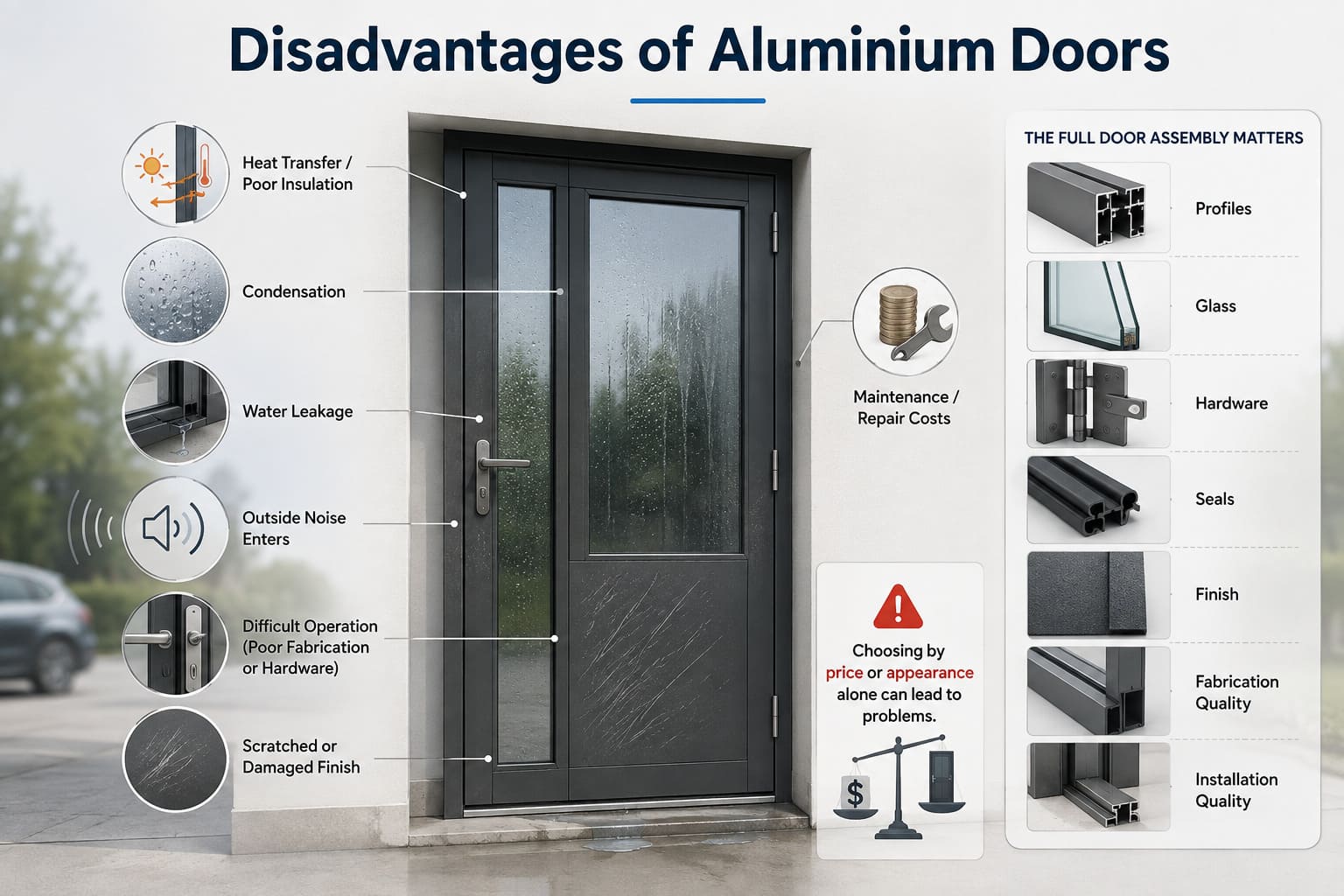
I often receive enquiries in which buyers compare aluminium doors as though every product has the same construction. In practice, two visually similar doors can perform very differently. The sections below explain each limitation and show which questions I believe professional buyers should ask before comparing suppliers.
Are Thermal Performance and Condensation Major Disadvantages of Aluminium Doors?
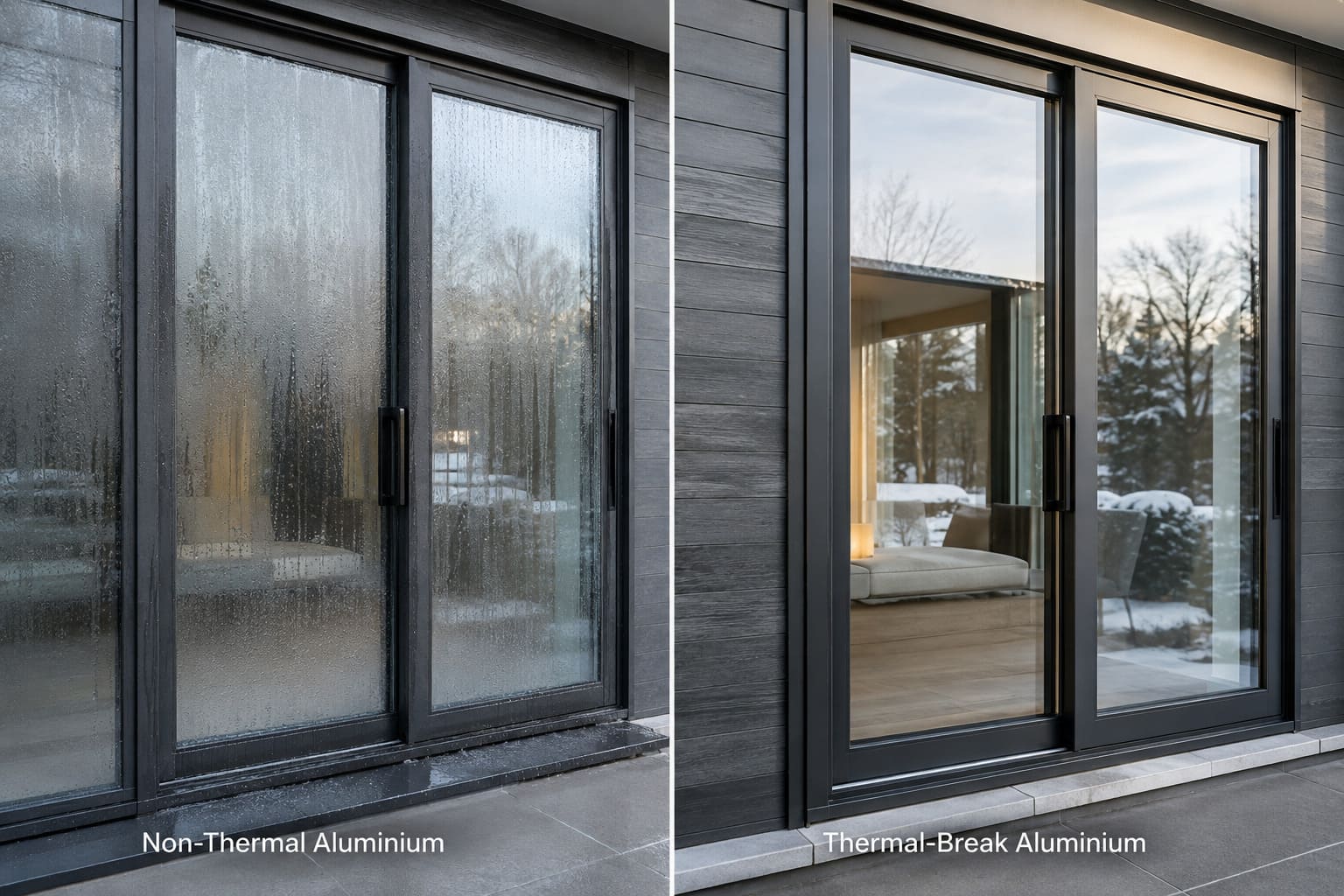
Aluminium conducts heat efficiently, which can become a problem in climates with large indoor-to-outdoor temperature differences. If buyers overlook the frame design, glazing, seals, and surrounding construction, the completed door may reduce occupant comfort and increase condensation risk.
The thermal limitation is genuine, but its importance depends on the application. I usually recommend that buyers compare non-thermal and thermal-break systems against the project climate, energy code, door location, glass specification, and required thermal value. A suitable thermal barrier can substantially reduce heat transfer through the aluminium frame.
Why does aluminium conduct so much heat?
Aluminium is a highly conductive metal. That property is useful in heat sinks, but it creates a thermal bridge when one continuous profile connects exterior and interior surfaces. Heat can travel through the frame more easily than through materials with lower conductivity.
A non-thermal aluminium door generally uses a continuous aluminium profile. A thermal-break aluminium door separates the inner and outer aluminium sections with a lower-conductivity barrier, commonly made from polyamide or another engineered insulating material.
I do not automatically recommend a thermal-break system for every enquiry. A non-thermal door may be appropriate for:
- Internal partitions
- Warehouses without strict temperature control
- Mild climates
- Utility buildings
- Entrances where energy performance is not a primary target
- Projects with limited performance requirements
A thermal-break design may be more suitable for:
- Air-conditioned or heated buildings
- Cold, hot, or mixed climates
- Hotels, apartments, villas, and offices
- Energy-efficient developments
- Exterior doors subject to strict building-envelope requirements
- Projects with a specified frame or whole-door U-value
Why can condensation occur?
Condensation can form when an interior surface becomes colder than the dew point of the surrounding air. A conductive frame may create colder internal surfaces in winter or under intensive air conditioning. However, the frame is only one part of the analysis.
I ask buyers to consider:
- Indoor and outdoor design temperatures
- Indoor relative humidity
- Glass type and edge-spacer design
- Thermal-break geometry
- Threshold construction
- Adjacent wall and floor interfaces
- Local ventilation conditions
- Installation details
| Configuration | Typical procurement advantage | Main limitation to evaluate |
|---|---|---|
| Non-thermal aluminium | Simpler construction and lower initial cost | Higher frame conductivity |
| Thermal-break aluminium | Better control of heat transfer | Higher cost and more complex fabrication |
| Single glazing | Lower purchase cost | Limited thermal and acoustic performance |
| Insulating glass | Better building-envelope performance | Added weight, cost, and hardware demand |
| Low-threshold design | Easier passage and accessibility | Water and air control may require extra attention |
Buyers should request test reports or calculations that relate to the proposed system and configuration. They should also verify whether a stated value applies to the frame, glass, sample size, or complete door assembly. I can support product-selection discussions, but a qualified façade consultant, engineer, or building-energy professional should confirm application-specific requirements.
Can Aluminium Doors Suffer from Air and Water Leakage?
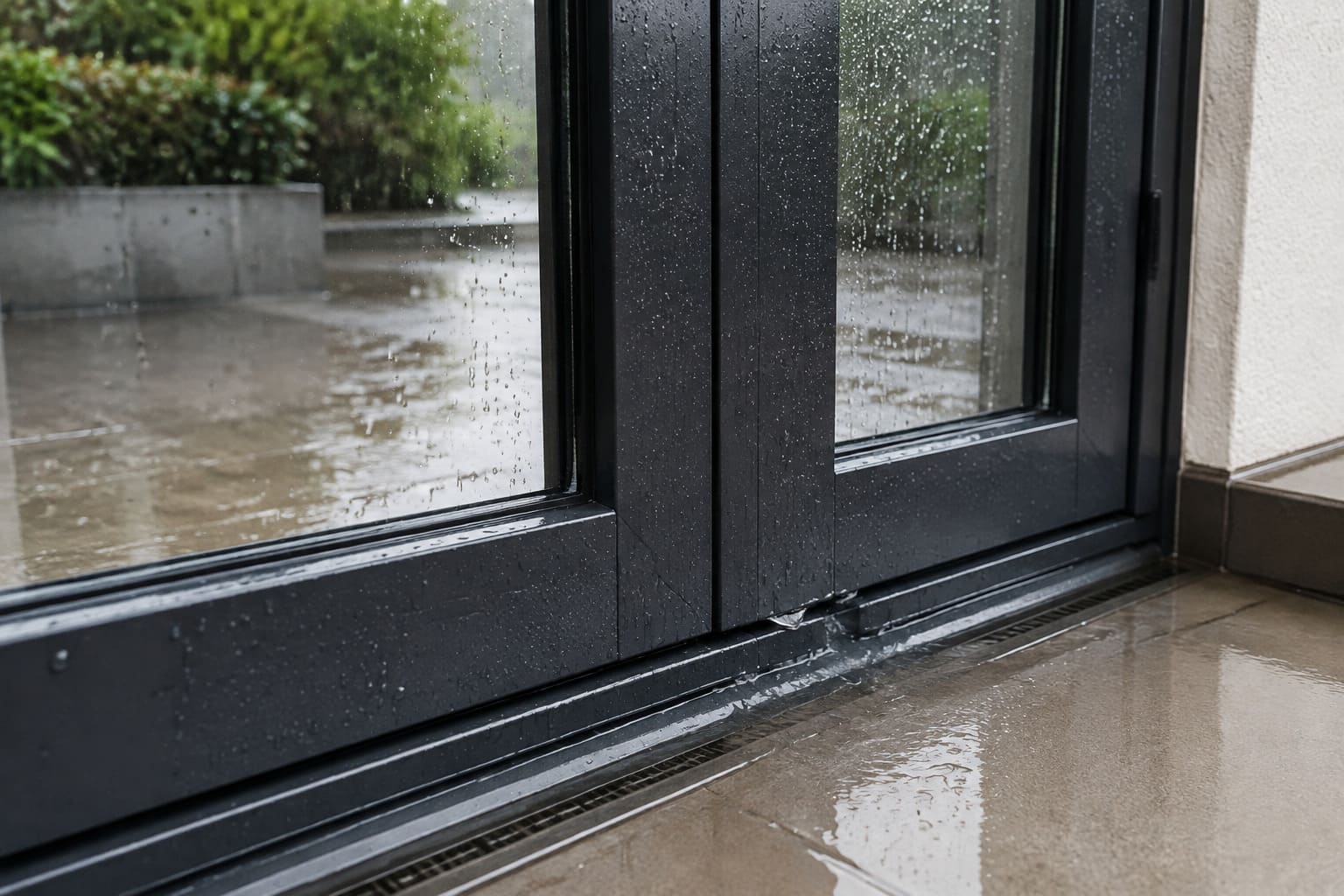
Air leakage and water penetration are serious risks, but I do not treat them as automatic aluminium defects. These problems often result from drainage design, gaskets, thresholds, hardware compression, fabrication tolerances, installation joints, or a door configuration that does not suit the exposure.
I evaluate leakage risk at the system level. Buyers should define the required air- and water-performance classifications, door size, opening type, wind exposure, sill condition, and installation method. They should then compare documented test evidence and production controls rather than assuming that a thick profile alone guarantees performance.
Where does leakage usually develop?
A door contains several interfaces that must work together. The aluminium profile may remain structurally sound while water or air passes through another part of the assembly.
Critical areas include:
- Gasket corners and joints
- Locking points
- Bottom seals
- Thresholds
- Glass-to-frame seals
- Drainage holes
- Frame-to-wall joints
- Mullion and transom connections
- Machined hardware openings
- Corners assembled with poor tolerances
I regularly see enquiries that specify only profile thickness and glass type. Those details matter, but they do not define air or water performance. A heavy profile cannot compensate for an unsuitable gasket layout or an incorrectly installed threshold.
Opening type changes the risk
Different door types manage pressure and water differently.
| Door type | Main advantage | Procurement concern |
|---|---|---|
| Hinged or casement door | Strong perimeter compression is possible | Hardware alignment and threshold sealing |
| Sliding door | Large openings and convenient operation | Interlock, track, drainage, and sill exposure |
| Lift-and-slide door | Better sealing than many basic sliding configurations | Hardware capacity, fabrication accuracy, and cost |
| Folding door | Wide clear opening | Multiple panel joints and hardware complexity |
| Pivot door | Architectural appearance and large sizes | Deflection, seals, floor interface, and hardware engineering |
Large doors need special attention. Panel width, height, glass weight, wind pressure, opening frequency, and hardware capacity affect how the system behaves. A configuration that works for a moderate residential opening may not suit a high-traffic hotel entrance or an exposed high-rise location.
Which documents should buyers request?
I suggest that professional buyers ask for:
- System drawings and cross-sections
- Gasket and drainage details
- Hardware schedules
- Maximum recommended panel dimensions
- Relevant air, water, and structural test reports
- Test specimen dimensions and configurations
- Fabrication inspection records
- Installation guidance
- Sealant and perimeter-joint responsibilities
Buyers should treat reports and certifications as documents to verify. A report for one tested specimen may not automatically cover every size, glass weight, threshold, or hardware variation. A qualified engineer or testing professional should assess whether the evidence applies to the intended project.
Is Weak Sound Insulation One of the Disadvantages of Aluminium Doors?
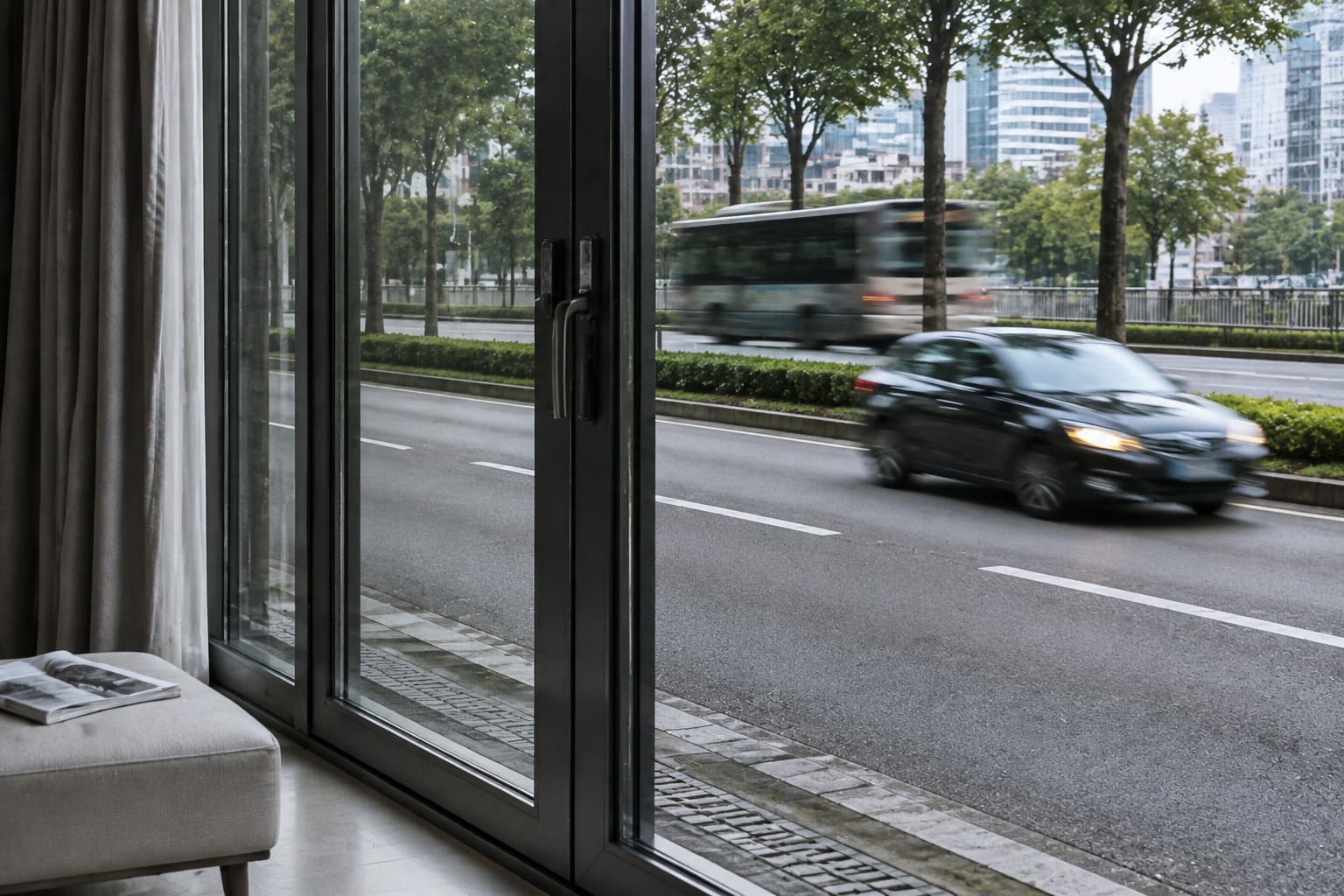
Some aluminium doors provide disappointing sound control, especially when buyers choose basic glass, loose seals, unsealed thresholds, or sliding configurations. However, I avoid describing weak acoustics as an unavoidable material problem because the complete assembly usually determines the result.
An aluminium door can support strong acoustic performance when its glass, frame cavities, seals, panel construction, threshold, and installation joints are designed together. Buyers should state the required acoustic rating and ask whether evidence applies to the complete door, not just the glass or an unrelated laboratory sample.
Why does glass matter so much?
Glass often occupies most of a glazed door’s surface area. Its thickness, lamination, cavity, asymmetry, and overall construction can have a major effect on sound transmission. A high-quality frame cannot make basic thin glass perform like a purpose-designed acoustic glazing unit.
Buyers commonly consider:
- Monolithic glass
- Laminated glass
- Insulating glass units
- Asymmetrical double glazing
- Acoustic laminated glass
- Opaque insulated panels
The best option depends on the noise source. Traffic noise, aircraft noise, conversation, machinery, and low-frequency music do not have identical sound spectra. I recommend that buyers obtain professional acoustic advice when a project has a formal performance target.
Small gaps can create large weaknesses
Airborne sound can pass through the same openings that allow air leakage. Therefore, gasket compression and installation quality are important. A door with expensive acoustic glass may underperform if it includes an open bottom gap or poorly sealed perimeter.
I review the following areas during configuration discussions:
- Perimeter seals: The design should maintain consistent contact when the door closes.
- Threshold seals: The project must balance accessibility, drainage, and acoustic control.
- Panel joints: Sliding, folding, and double-leaf doors contain additional interfaces.
- Hardware: Locks and hinges should create suitable and repeatable compression.
- Installation joints: The frame-to-wall connection should not become an acoustic bypass.
- Ventilation openings: Louvres or transfer grilles can limit the overall result.
I often remind buyers that a glass certificate is not a complete door certificate.
Buyers should compare test specimen size, opening type, threshold, glass, seals, and hardware with the proposed production configuration. They should also clarify whether the supplier quotes a laboratory-tested value, a calculated estimate, or a glass-only rating. Those terms are not interchangeable.
Can Aluminium Door Finishes Corrode, Fade, or Become Damaged?
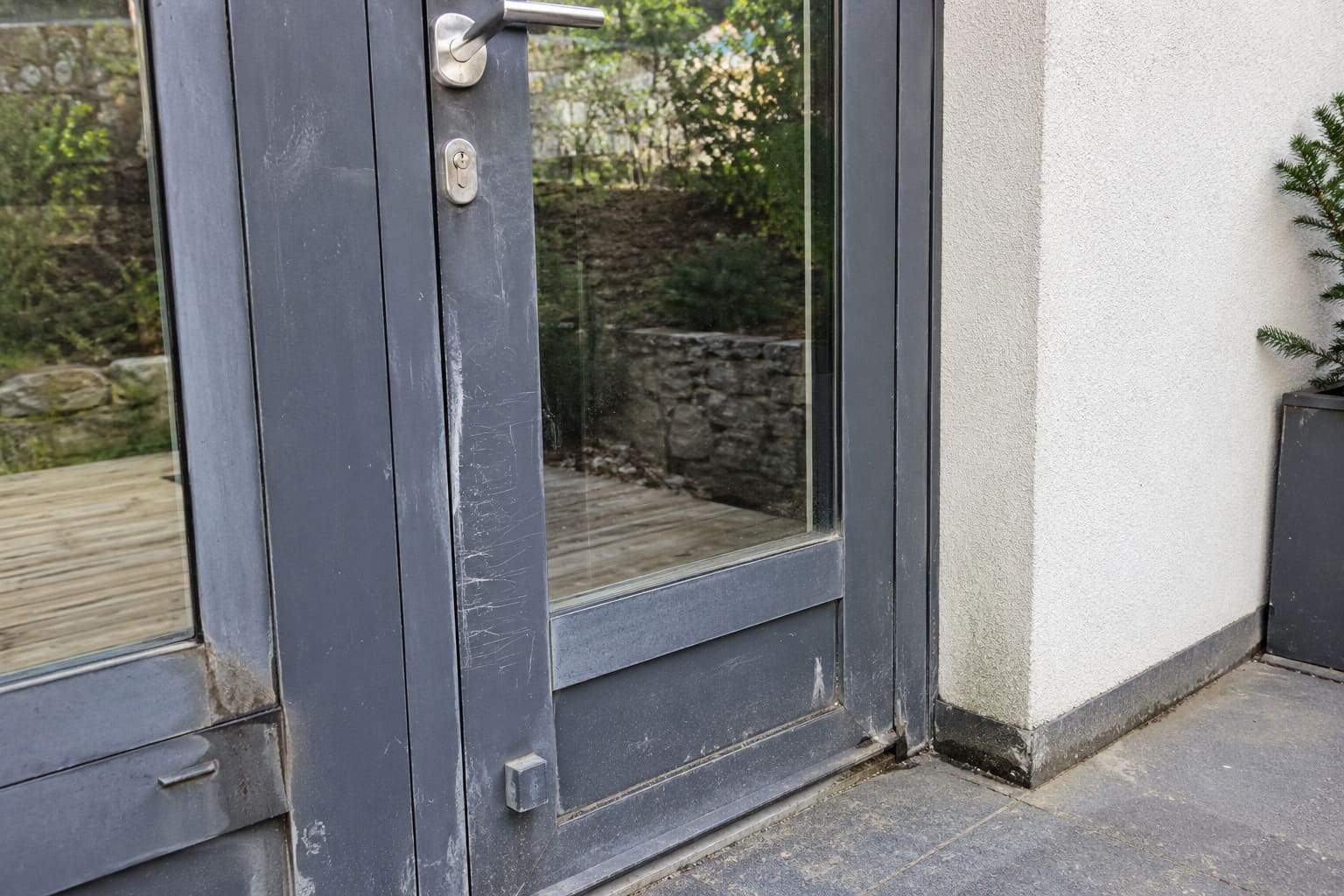
Aluminium naturally forms an oxide layer, but finished aluminium doors can still experience corrosion, fading, chalking, staining, or mechanical damage. The risk increases when buyers specify an unsuitable alloy, pretreatment, coating system, film thickness, color, packaging method, or maintenance procedure for the exposure.
I recommend choosing the surface treatment according to climate and building location. Powder coating, anodizing, wood-grain finishes, and PVDF coating have different appearances, processes, costs, and performance considerations. Buyers should define a recognized finish standard and verify the supplier’s pretreatment and quality-control procedures.
What causes corrosion on aluminium doors?
Aluminium does not rust like carbon steel, but it can corrode. Coastal salt, industrial pollution, trapped moisture, alkaline construction materials, incompatible metals, and coating damage can increase the risk.
Galvanic corrosion deserves particular attention. It can occur when dissimilar metals remain in electrical contact in the presence of an electrolyte. Fasteners, reinforcement, hardware, anchors, and adjacent materials should therefore be selected and isolated carefully.
I suggest reviewing these conditions before approving a finish:
- Coastal distance and salt exposure
- Industrial or chemical exposure
- UV intensity
- Rainfall and humidity
- Cleaning frequency
- Contact with concrete, mortar, or cement wash
- Contact with steel, copper, or other metals
- Risk of scratching during transport and installation
- Expected color consistency between production batches
How do common finishes compare?
| Finish | Common reasons for selection | Points buyers should verify |
|---|---|---|
| Powder coating | Wide color range and efficient production | Pretreatment, coating thickness, cure control, and approved color |
| Anodizing | Metallic appearance and integrated oxide layer | Anodic film specification, shade variation, and sealing quality |
| Wood-grain finish | Decorative timber-like appearance | Base coating, transfer process, pattern approval, and UV requirements |
| PVDF coating | Often selected for demanding architectural exposure | Coating system, application process, color control, and applicable standard |
I avoid making universal lifespan claims because exposure, maintenance, process control, and specification all influence durability. Buyers should request finish samples, color references, inspection criteria, and relevant test documents. They should also confirm which standard the supplier uses rather than accepting terms such as “outdoor quality” without a measurable definition.
Packaging also matters. Protective film can reduce scratching, but an unsuitable film or excessive storage time may leave adhesive residue. Profiles can rub together during sea transport if separators and restraints are inadequate. I therefore encourage buyers to include packaging requirements in the purchase specification, especially for finished frames and fabricated doors.
Do Aluminium Doors Cost More or Require More Maintenance?
Aluminium doors can carry a higher initial price than basic alternatives, especially when a project requires thermal breaks, premium glass, large sections, multi-point hardware, special finishes, or tested performance. Low-priced systems, however, can create hidden costs when their quotations omit essential components or services.
I recommend comparing total configuration and lifecycle risk rather than headline price. Buyers should normalize quotations for aluminium alloy, profile weight, finish, glass, hardware, seals, fabrication, packaging, testing, installation support, shipping scope, and warranty terms before deciding which offer provides better value.
Why can quotations differ so much?
Two suppliers may use the same door dimensions while quoting very different products. One quotation may include premium hardware, insulating glass, complete locks, export packaging, and fabrication. Another may show only the frame or may use a lighter system with fewer accessories.
I have handled quotation discussions where the buyer initially asked only for a price per square metre. I usually need more information before I can prepare a meaningful comparison. A square-metre price can hide differences in panel weight, hardware quantity, glass processing, and fixed fabrication costs.
A responsible supplier should ask about:
- Project country and climate
- Building type and door location
- Opening dimensions
- Door quantity
- Opening direction and method
- Usage frequency
- Wind and weather exposure
- Thermal and acoustic targets
- Air- and water-performance requirements
- Glass composition
- Hardware brand or performance level
- Color and finish standard
- Installation responsibility
- Packaging and shipping terms
Which costs can buyers overlook?
| Cost category | Common specification gap | Possible procurement risk |
|---|---|---|
| Glass | Thickness or safety processing is unclear | Variation in safety, weight, and performance |
| Hardware | Brand and load capacity are omitted | Difficult operation or early replacement |
| Seals | Material and layout are unspecified | Air, water, or acoustic weakness |
| Finish | Standard and pretreatment are absent | Color or durability disputes |
| Fabrication | Machining and assembly scope is unclear | Rework at destination |
| Packaging | Export protection is not defined | Transit damage |
| Testing | Required reports are not listed | Approval delays |
| Installation | Joint materials and responsibility are unclear | Leakage and alignment problems |
Do aluminium doors need maintenance?
Aluminium frames usually need routine cleaning and inspection rather than intensive treatment. However, the complete door includes moving and replaceable parts. Hardware may need adjustment or lubrication. Drainage paths need to remain open. Gaskets and sealants may eventually require inspection or replacement according to their condition and the manufacturer’s guidance.
Large or frequently used doors can place greater loads on rollers, hinges, locks, and corner joints. Buyers should ask the supplier for a maintenance schedule and spare-parts policy. Distributors and contractors should also check whether replacement hardware will remain available in their market.
The lowest purchase price does not always produce the lowest total cost. At the same time, the most expensive system is not automatically the correct one. I believe the best commercial decision comes from matching a documented configuration to the project’s actual requirements.
What Should Buyers Check Before Ordering Aluminium Doors?
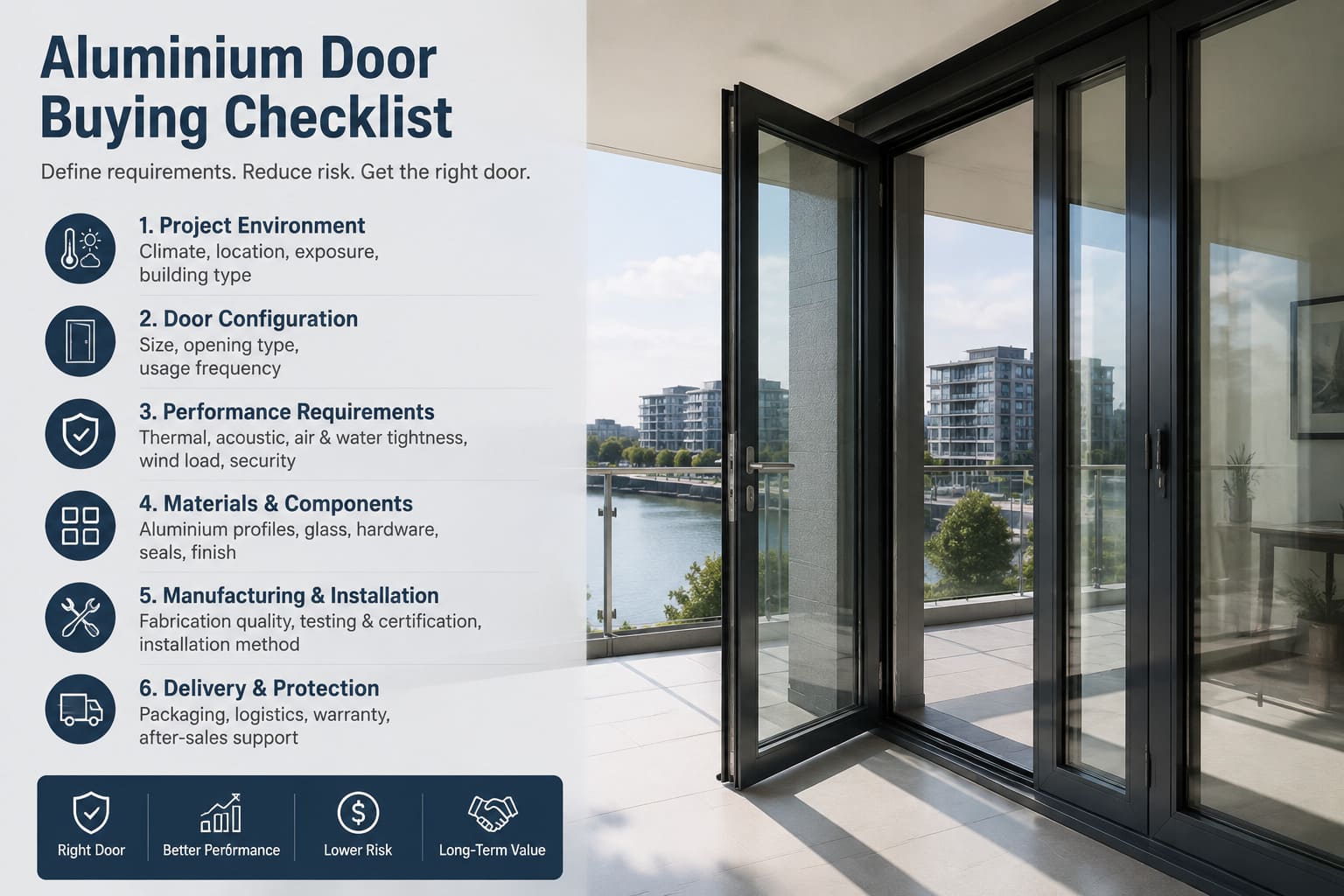
The greatest purchasing risk appears when a buyer approves a door before defining its operating environment and expected performance. An incomplete request can produce incomparable quotations, unsuitable configurations, and disputes over components that neither party clearly assigned.
I use a project-fit checklist before recommending a system. Buyers should confirm climate, application, size, opening type, use frequency, performance targets, finish, glass, hardware, seals, installation, testing, packaging, and logistics. They should then record those requirements in drawings, schedules, and the purchase contract.
A practical specification checklist
I recommend that procurement teams organize their requirements into five groups.
1. Project conditions
- Project country and city
- Building type and height
- Exterior or interior location
- Coastal, industrial, or sheltered exposure
- Indoor and outdoor temperature conditions
- Wind pressure and driving-rain exposure
2. Door design
- Structural opening size
- Frame and panel dimensions
- Single, double, sliding, folding, lift-and-slide, or pivot operation
- Inward or outward opening
- Traffic level and expected operating frequency
- Accessibility and threshold requirements
- Emergency-exit or fire-related requirements, where applicable
3. Performance requirements
- Thermal performance
- Acoustic performance
- Air permeability
- Water penetration resistance
- Structural or wind-load resistance
- Security level
- Safety glazing requirements
Project professionals should define and verify these targets according to local regulations. Standard aluminium doors should not be assumed to provide fire resistance, smoke control, forced-entry resistance, or emergency-exit compliance unless the specific complete system has suitable evidence and approvals.
4. Component responsibility
Buyers should identify who supplies and approves:
- Aluminium profiles
- Thermal-break materials
- Glass and glazing accessories
- Locks, handles, hinges, and rollers
- Gaskets and weather seals
- Fasteners and anchors
- Perimeter sealants
- Flashings and sill pans
- Installation labor
- Testing and commissioning
5. Supplier verification
I advise buyers to evaluate whether a manufacturer can control the required processes. Relevant capabilities may include extrusion, powder coating, anodizing, wood-grain finishing, PVDF coating, thermal-break assembly, machining, and finished door fabrication.
Buyers can request:
- Factory capability information
- Approved drawings and bills of materials
- Material certificates
- Finish inspection records
- Hardware data sheets
- Relevant system test reports
- In-process and final inspection plans
- Packaging specifications
- Traceability or batch records
- Pre-shipment inspection arrangements
A factory visit, third-party inspection, sample approval, or pre-production prototype can reduce risk for larger orders. Buyers should verify every certificate and test report for its scope, issuing body, date, specimen configuration, and relevance to the project. A qualified professional should make the final application-specific judgment.
Frequently Asked Questions
Are aluminium doors bad for cold climates?
Aluminium doors are not automatically unsuitable for cold climates. I recommend a properly designed thermal-break frame, suitable insulating glass, effective seals, and carefully detailed installation. Buyers should verify the complete door’s thermal and condensation performance against local climate conditions and building-energy requirements.
Are non-thermal aluminium doors always a poor choice?
Non-thermal systems are not always a poor choice. They can suit interior areas, mild climates, non-conditioned buildings, warehouses, and projects without strict thermal targets. I advise buyers to base the decision on project conditions rather than assuming that every exterior or interior opening needs the same system.
Do aluminium doors leak more than other doors?
Aluminium doors do not inherently leak more than other materials. Leakage depends on the system design, gaskets, drainage, threshold, fabrication, hardware adjustment, installation, and exposure. Buyers should request relevant test evidence and confirm that the tested configuration resembles the proposed door.
Why are some aluminium doors difficult to open?
Difficult operation can result from excessive panel weight, undersized hinges or rollers, frame distortion, poor alignment, incorrect fabrication, debris in tracks, or installation movement. I recommend checking glass weight, hardware capacity, maximum panel dimensions, and adjustment procedures before production.
How should I compare quotations from aluminium door suppliers?
I compare quotations using the same drawings and component schedule. Buyers should normalize the profile system, alloy, finish, glass, hardware, seals, fabrication, packaging, testing, shipping terms, and installation scope. A low headline price has little meaning when suppliers quote different configurations.
Conclusion
The disadvantages of aluminium doors include thermal conductivity, condensation risk, possible leakage, variable acoustic performance, finish damage, and higher costs for advanced configurations. However, I find that buyers can manage many of these risks by evaluating the complete system rather than the frame alone. Project teams should define measurable requirements, compare quotations by scope, verify supplier documents, and obtain qualified technical advice where needed. For a drawing-based quotation or a customized B2B aluminium door solution, contact us at +86 18366906856 or [email protected].